This essay first appeared in our weekly Scripture reflection newsletter on September 6, 2025.
Wis 9:13-18; Phil 9-10, 12-17; Lk 14:25-33
You can find the readings for the 23rd Sunday of Ordinary Time here.
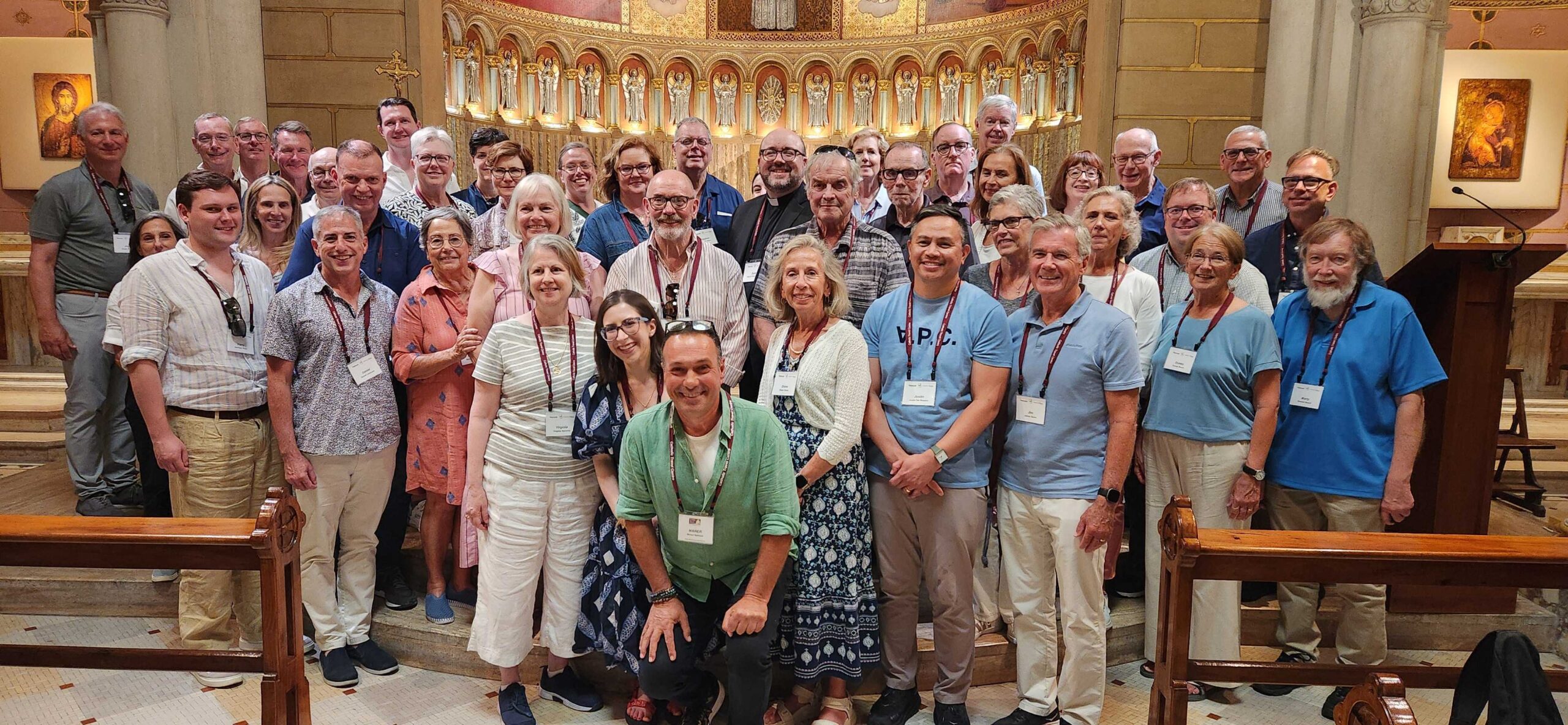
Along with the rest of the Outreach team (Michael O’Loughlin, Jack Consolie and Alessandra Rose) and 40 wonderful pilgrims, I’ve spent the last few days in Rome. This trip has been—as you may have seen on this website, on social media, or perhaps in the secular media—the first Outreach pilgrimage, which was organized in light of the Jubilee Year. And two days before we arrived, I was honored to have an audience with Pope Leo XIV, as you may also have read.
Now, what does all this have to do with today’s Gospel from Luke, in which Jesus says, rather harshly it seems, that one must hate “one’s father and mother, wife and children, brothers and sisters, even his own life” in order to follow him? And Jesus does use that strong word: hate. Matthew’s Gospel softens this with Jesus saying that his disciples simply shouldn’t love father or mother, or son or daughter, more than they love Jesus.
Again, what does our pilgrimage and Pope Leo have to do with all that?
What the Gospel does mean is that all of these people have had to leave some things behind in order to embrace the life to which God called them.
First of all, Jesus’ warning doesn’t mean that he wants us to hate our families. Jesus loved his mother, his foster father Joseph and presumably all the relatives in his (presumably large) extended family in Nazareth. Remember that one of his last acts on the Cross is to place his mother in the care of the Beloved Disciple (Jn 19:26-27). He loved Mary so much that he wanted her to be cared for.
It also doesn’t mean that I’m implying that Pope Leo “hates” his family. (By the way, what I’m about to write is not based on anything he told me.) His well documented affection for his two brothers—one in Chicago, Illinois; and one in Port Charlotte, Florida, is plain for all to see. And I’m also not implying that anyone on our pilgrimage “hates” their families. In fact, many of our pilgrims are loving parents of LGBTQ children.
What the Gospel does mean is that all of these people—Jesus of Nazareth (yes, I know he’s more than just a person), Pope Leo XIV, and all our pilgrims—have had to leave some things behind in order to embrace the life to which God called them.
Who are seen as “outcasts” today?
During a talk for our pilgrims, John Dardis, S.J., who works at the Jesuit Curia in Rome, offered a striking image that moved many people—myself included. He said that instead of thinking of God’s will, which is sometimes thought of in harsh terms, one might think of “God’s dreams.”
So what are God’s dreams for you? Sometimes that takes a while to understand. “Who can conceive of what the Lord intends?” as the first reading says today. But it’s important to wonder about that. If you are Jesus, the “dream” of the Father for you is to embody the Father’s love, embark on a public ministry of preaching and healing and finally suffer, die and rise again. But to do this, Jesus had to let go of the need for his family’s approval. Not to “hate” them. But not let them dissuade him (as they try to do in Mark 3) from a ministry that seems, at least for a time, to confuse them.
Indifference means being free enough to follow God’s deepest desires for us—in other words, our dreams.
If you’re Robert Prevost, God’s dreams for you are to be an Augustinian priest, then the prior general of your order, then a bishop, then a cardinal and then pope. Part of fulfilling this dream also means giving something up—perhaps the promise of spending all your holidays with your family. Perhaps even a certain amount of freedom of movement, particularly as pope.
If you’re an LGBTQ person, or the parent or brother or sister of an LGBTQ person, God’s dreams for you might be to love your child or brother or sister as they are, not as you might have expected them to be, and in that way to experience love in a new way. But that might mean giving up the comfort of knowing that you’ll be accepted everywhere, an experience some of our pilgrims have shared.
Jesuits call this “indifference,” which can seem an unfortunate word in our spiritual lexicon. Still, as Anthony SooHoo, S.J., a Jesuit who teaches at the Pontifical Biblical Institute, reminded our pilgrims, indifference means being free enough to follow God’s deepest desires for us—in other words, our dreams.
God has a dream for all of us. To follow it, we must let go of certain things. That doesn’t mean hating our family. But it does mean loving God more than anything else.