I grew up within the walls of a non-denominational church that stood apart from Kenya’s mainstream umbrella bodies—independent of the Protestants, Catholics and Evangelicals. My religious foundation was not a single path but a mixture of everything. After my parents separated when I was nine, my life became a series of seasonal shifts. My brother and I had to move between the homes of relatives on both my maternal and paternal sides, being exposed to vastly different experiences in each household.
In this landscape of displacement, I learned about the solemnity of the Catholic liturgy in one house and the rigorous discipline of the Africa Inland Church or Anglican traditions in another. The Catholic tradition in particular taught me the language of the sacred. In the quiet, incense-filled rhythm of the Mass, I found a sense of the Sacramental—the profound idea that grace exists and works through material things even when it is hidden from our eyes. I became a spiritual chameleon, learning early on how to adapt my voice to whichever sanctuary I called home.
Those early encounters with the “sacred” gave me a place to anchor my soul, even as I began to hide my true self from fear of the unknown and for my own safety.
After high school, I moved in with my Aunt in Nakuru, the fourth largest city in Kenya, and began attending a non-denominational church. For years, I was a son of that church, serving as a church planter and working alongside mentors to establish congregations across Kenya. I believed that space was the one place on earth where everyone was safe under the wings of God’s grace. However, my inner, silent, struggles of identity pushed me into a deep, almost desperate devotion to church activities and service. I poured myself into the ministry, hoping that by building the church I could fix what I felt was broken inside. Within that sanctuary I chose peace in silence, never introducing or speaking of my true self. The air was thick with the unspoken; rarely, if ever, did the topic of LGBTQ identity arise and when it did, it was only as a shadow to be frowned upon.
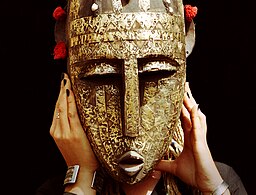
Beneath the surface of my visible ministry, I was perfecting a different kind of theology—the Theology of the Mask. In the religious landscape of Kenya, survival depends on the performance of an identity that satisfies the expectations of family and institution. As a young man, I felt the constant, exhausting need to prove my manhood. Engaging with the opposite gender was always a result of societal or peer pressure; it was a way of establishing my place in a world that demanded a certain kind of masculinity. My relationships never lasted, but I always carried a ready alibi—a spiritual or professional excuse to explain away the distance I felt.
Only my elder brother knew about my orientation. He viewed it not as an identity, but as a bad habit he hoped I would outgrow. In our culture, while teenagers keep each other’s secrets, there is a heavy expectation for an older brother to straighten out his sibling. I remember the visible relief I saw him feel when I was appointed chapel prefect in high school. For him, it meant I had finally transformed. I believe that one of the reasons he never outed me was our shared history of shuttling from one relative’s home to another. In the midst of that instability, he feared lighting another fire that might burn down the few bridges of support we had left.
I realized that Jesus was not the one holding the stones; He was the one standing in the dirt with those of us who have been cast out.
This internal fragmentation culminated at the age of 34. Under the immense pressure of church tradition and a desperate need to remain an insider, I surrendered at last to societal pressure and married a woman. It was a step taken not out of internal truth, but out of a desperate need to fit a mold that was never made for me. In a country where Section 162 of our Penal Code punishes same-sex acts with up to 14 years in prison, this performance was my only shield.
For decades, I lived in this fragmentation of soul. I preached about the freedom of Christ while feeling like a prisoner of my own mask. This is why a tragedy in Nakuru, in 2022, broke me so completely. I was serving in the non-denominational church there when a young woman in my congregation took her own life because she could not reconcile her identity with her faith. In her death, I saw my own reflection. I realized that by maintaining my “mask” to keep my position of influence, I was silently validating the very system that made her feel her life was not worth living.
When I finally found the courage to face my leadership in the hope of midwifing some change in acceptance, the reaction was swift. I was sidelined, my social standing vanished and I became a stranger in the congregation I had spent my life serving.
Yet, it was in this rejection that I truly met Jesus. I moved from a religion of rules to a daily walk with a Savior who was also viewed with “pure judgment and contempt” by the religious institutions of His day.
I began to see that my authenticity was not a sin to be hidden but a sacred offering of my whole self to God. I realized that the true “living sacrifice” (Romans 12:1) was the courage to bring my hidden truth into the light, trusting that God is glorified more by our wholeness than by our hollow performances.
I am a man journeying uphill towards living in my truth, breathing the thin air of honesty.
Today, my journey has led me to Nairobi, where life is lived in a state of high alert. Even our spaces of refuge are under constant threat. My friend Peter once invited me to a meeting where he was hosting families of LGBTQ individuals to inform them about acceptance; the location had to be kept secret to avoid attacks. A member of a county assembly had been invited, and I can never forget the look she gave me when Peter introduced me—a look of pure judgment and contempt. It reminded me that even in safe rooms, the threat of the wider society is never far away. This is the tension of our sanctuary—it is a place of peace that must be guarded like a fortress.
The pillar I once was in my local church may appear to have been diminished, but I am gradually working on building an authentic life with God. I carry with me the invisible scars of the soul, marks of a lifetime spent hiding and the pain of being cast out by the family of faith I helped build. I live with the uncertainty of whether I will suffer fresh wounds in the future, as the path of truth in this land is often paved with thorns.
Yet, I am more certain than ever of the need to hold together for the right course. Despite the rejection, I still believe the church can become a place where truth and belonging live harmoniously . Though I am still considered a false leader by the institutions I once served, I rest in the knowledge that God knew me before He formed me in my mother’s womb, and God is not surprised by my existence.
In a land where our existence is contested, simply choosing to hold onto both our faith and our truth is our most profound act of resistance. I trust that Christ is for me (Romans 8:31) and He will uphold my authenticity.